He walked up to a cliff. His feet brushing against the coarse ground as he paced. His eyes looked beyond the cliffs and saw a desert of dry dead plants, where no animals inhabit, where no man would want to wander within.
The wind blew against his chest, as if whispering a silent song to him. Slowly, steadily, it pushed against him. Gently, it brushed his hair, as if comforting him.
He stared into silence, into the void land, into the skies. Nothing seemed to bring enjoyment anymore. He felt void. He felt silent. He felt... depressed.
Nothing could put a smile on his face anymore. The wind tried to push his lips upward at each end, but failed. All his eyes saw was lost, despair, emptiness.
Sunday, December 30, 2007


Monday, December 17, 2007
My Father's Hands

I read this post at Crystal's blog and I thought it is a beautiful story. Enjoy.
My Father’s Hands
His hands were rough and exceedingly strong. He could gently prune a fruit tree or firmly wrestle an ornery mule into harness. He could draw and saw a square with quick accuracy. He had been known to peel his knuckles upside a tough jaw. But what I remember most is the special warmth from those hands soaking through my shirt as he would take me by the shoulder and, hunkering down beside my ear, point out the glittering swoop of a blue hawk, or a rabbit asleep in its lair. They were good hands that served him well and failed him in only one thing: they never learned to write.
My father was illiterate. The number of illiterates in our country has steadily declined, but if there were only one I would be saddened, remembering my father and the pain he endured because his hands never learned to write.
He started in the first grade, where the remedy for a wrong answer was ten ruler strokes across a stretched palm. For some reason, shapes, figures, and recitations just didn’t fall into the right pattern inside his six-year-old towhead. Maybe he suffered from some type of learning handicap such as dyslexia. His father took him out of school after several months and set him to a man’s job on the farm.
Years later, his wife, with her fourth-grade education, would try to teach him to read. And still later I would grasp his big fist between my small hands and awkwardly help him trace the letters of his name. He submitted to the ordeal, but soon grew restless. Flexing his fingers and kneading his palms, he would declare that he had had enough and depart for a long, solitary walk.
Finally, one night when he thought no one saw, he slipped away with his son’s second grade reader and labored over the words, until they became too difficult. He pressed his forehead into the pages and wept. “Jesus-Jesus-not even a child’s book?” Thereafter, no amount of persuading could bring him to sit with pen and paper.
From the farm to road building and later factory work, his hands served him well. His mind was keen, his will to work unsurpassed. During World War II, he was a pipe fitter in a shipyard and installed the complicated guts of mighty fighting ships. His enthusiasm and efficiency brought an offer to become line boss-until he was handed the qualification test. His fingers could trace a path across the blueprints while his mind imagined the pipes lacing through the heart of the ship, He could recall every twist and turn of the pipes. But he couldn’t read or write.
After the shipyard closed, he went into the cotton mill, where he labored at night, and stole from his sleeping hours the time required to run the farm. When the mill shut down, he went out each morning looking for work-only to return night after night and say to Mother as she fixed dinner, “They just don’t want anybody who can’t take their tests.”
It had always been hard for him to take a stand before a man and make an X mark for his name, but the hardest moment of all was when he placed “his mark” by the name someone else had written for him, and saw another man walk away with the deed to his beloved farm. When it was over, he stood before the window and slowly turned the pen he still held in his hands-gazing, unseeing, down the mountainside. I went down to the spring house that afternoon and wept for a long while.
Eventually, he found another cotton-mill job, and we moved into a mill house village with a hundred look-alike houses. He never quite adjusted to town life. The blue of his eyes faded; the skin across his cheekbones became a little slack. But his hands kept their strength, and their warmth still soaked through when he would sit me on his lap and ask that I read to him from the Bible. He took great pride in my reading and would listen for hours as I struggled through the awkward phrases.
Once he had heard “a radio preacher” relate that the Bible said, “The man that doesn’t provide for his family is worse than a thief and an infidel and will never enter the Kingdom of Heaven.” Often he would ask me to read that part but I was never able to find it. Other times, he would sit at the kitchen table leafing through the pages as though by a miracle he might be able to read the passage should he turn to the right page. Then he would sit staring at the Bible, and I knew he was wondering if God was going to refuse him entry into heaven because his hands couldn’t write.
When Mother left once for a weekend to visit her sister, Dad went to the store and returned with food for dinner while I was busy building my latest homemade wagon. After the meal he said he had a surprise for dessert, and went out to the kitchen, where I could hear him opening a can. Then everything went quiet. I went to the doorway, and saw him standing before the sink with an open can in his hand. “The picture looked just like pears,” he mumbled. He walked out and sat on the back steps, and I knew he had been embarrassed before his son. The can read “Whole White Potatoes,” but the picture on the label did look a great deal like pears.
I went and sat beside him, and asked if he would point out the stars. He knew where the Big Dipper and all the other stars were located, and we talked about how they got there in the first place. He kept that can on a shelf in the woodshed for a long while, and a few times I saw him turning it in his hands as if the touch of the words would teach his hands to write.
Years later, when Mom died, I tried to get him to come live with my family, but he insisted on staying in his small frame house on the edge of town with a few farm animals and a garden plot. His health was failing, and he was in and out of the hospital with several mild heart attacks. Old Doc Green saw him weekly and gave him medication, including nitroglycerin tablets to put under his tongue should he feel an attack coming on.
My last fond memory of Dad was watching as he walked across the brow of a hillside meadow, with those big, warm hands - now gnarled with age - resting on the shoulders of my two children. He stopped to point out, confidentially, a pond where he and I had swum and fished years before. That night, my family and I flew to a new job and a new home, overseas. Three weeks later, he was dead of a heart attack.
I returned alone for the funeral. Doc Green told me how sorry he was. In fact, he was bothered a bit, because he had just written Dad a new nitroglycerin prescription, and the druggist had filled it. Yet the bottle of pills had not been found on Dad’s person. Doc Green felt that a pill might have kept him alive long enough to summon help.
An hour before the chapel service, I found myself standing near the edge of Dad’s garden, where a neighbor had found him. In grief, I stopped to trace my fingers in the earth where a great man had reached the end of life. My hand came to rest on a half-buried brick, which I aimlessly lifted and tossed aside, before noticing underneath it the twisted and battered, yet unbroken, soft plastic bottle that had been beaten into the soft earth.
As I held the bottle of nitroglycerin pills, the scene of Dad struggling to remove the cap and in desperation trying to break the bottle with the brick flashed painfully before my eyes. With deep anguish I knew why those big, warm hands had lost in their struggle with death. For there, imprinted on the bottle cap, were the words, “Child Proof Cap - Push Down and Twist to Unlock.” The druggist later confirmed that he had just started using the new safety bottle.
I knew it was not a purely rational act, but I went right downtown and bought a leather-bound pocket dictionary and a gold pen set. I bade Dad good-bye by placing them in those big old hands, once so warm, which had lived so well, but had never learned to write.
Reader's Digest, 1976 May
Review on Three Weeks With My Brother
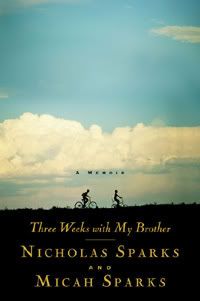 Three Weeks with My Brother
Nicholas and Micah Sparks
A Memoir
Time Warner Books
Rating: 8/10
Brief introduction:
Having lost their parents to a horse-riding accident and a car wreck, and their sister to brain cancer, Nicholas and Micah Sparks, in their mid-thirties, took a three-week journey to some of the wonders of the world - the lost city of Machu Picchu high in the Andes, mysterious Easter Island, and Ayers Rock in the Australian outback - to reawaken their shell-shocked selves, hoping to recapture lost faith and shore up ailing optimism along the way.
Daredevil Micah and the more serious, introspective Nicholas recall their childhood adventures and the tragedies that tested their faith. As moving and emotionally riveting as Nicholas Sparks' bestselling works of fiction and narrated with irrepressible humor and rare candor, Three Weeks With My Brother reminds us to cherish the joyful times of our lives . . .
***************************************
It would be difficult for many to imagine themselves being close to their siblings. By saying close, I really mean close. No topic would be under the do-not-discuss-about-it-or-I'll-beat-the-crap-out-of-you list; instead, everything - from the most personal to the most 'discussable' subject - can be talked about.
Three Weeks With My Brother, a memoir, shows the dynamics existing in the relationship between two brothers. The traditional belief that one has to "keep certain matters" to oneself is seemingly nonexistent. Somehow, as I read this book, I find myself wishing that I could be as close to my siblings and god brother as Nicholas Sparks and Micah Sparks.
At the same time, what I really liked about this book is also the fact that two men - not women who would many often (I know it's very discriminating and cliche) break down easily - learning difficult lessons of life and coping with the stresses of life, and deaths. They have struggled a whole lot and experienced deaths of their parents and sister. I simply couldn't imagine myself going through the problems they experienced; I would break down eternally if I ever did.
I am somewhat amazed at Sparks' ability to link the present enjoyment with the past. When I write, many often I find myself wanting to do that but unable to do so. This, in my opinion, is worthy of praise.
But above all, somehow I am attracted to the character Nicholas Sparks portrayed in the story. He is a very busy man, who used to stress himself out in everything. He used to get very little sleep, and has to work himself until the point of break down. I guess I am somewhat alike him, discounting the part of getting only three hours of sleep per day.
I would recommend you to read this book if you want to read something heart-warming book. I've never grown bored while reading the book, instead I kept flipping. Honestly, I'm not one who reads a lot of memoirs, yet somehow this book attracted me.
Excellent and heart-warming, I say. Read it.
Saturday, December 15, 2007
None Will Make It
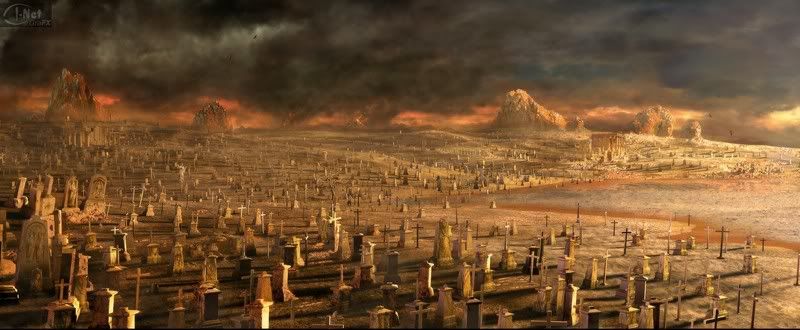
Solemn was spelled all over his face as he ascended the pulpit steps. Turning to look at the complacent congregation, he leaned against the Bible stand before him and peered into each member's eyes, scrutinizing them. His glare bore warning and uneasiness blanketed the church of 12,000 members.
He paused for a long time, his mind searching for words to say. He recalled the past - how hard he worked to get the number of members grow from 10 to 12,000; how many sleepless nights he had endured, kneeling at his bedside, praying earnestly with tears rolling down his face; how many painful conversations he had with members unconcerned of their spiritual life. He sighed.
Members looked at him, wondering why was he standing on the pulpit wordlessly. They examined his face. For twenty years, their pastor - Pastor Henry - had poured out an immeasurable extent of energy, effort and time to raise this church; it was everything he had and everything he wanted to see grow.
Pastor Henry stood there, breathing heavily. His heart felt like a sinking ship drowning into the deepest seas. How should he begin his sermon when he knew what God had told him to do? How could he say such things? People of this era wanted to hear what they wanted to hear - prosperity and blessings, and nothing else. How could he say otherwise? But at the same time, how could he defy God's commands? How could he go against the Almighty God? How could he be disobedient, what more, to the King of kings?
Whispers began reverberating throughout the large hall. People began bending toward their friends, whispering questions concerning the Pastor. No doubt they were curious, hoping nothing was wrong with Pastor Henry. But what they saw wasn't what they thought; he looked petrified for a moment, and hasn't been speaking since ascending the stage. Normally, Pastor Henry would begin his message with enthusiasm and a broad smile; but he had solemnness on his face this morning.
"Church," finally Pastor Henry begun, "I did not prepare my sermon this morning." The congregation began speaking to each other, shocked at what Henry had just said. A pastor was supposed to have his sermon prepared every Sunday. That was his job.
"Revelation has spoken of seven churches, and these churches represent the present churches. The sins mentioned in those churches are also present in churches these days. However, there was only one church that wasn't condemned but praised. It is Philadelphia." Pastor Henry's words were sharp and distinct. Noises lessened as they listened to their pastor speak.
"You see, churches are representatives of God on this earth. Members of the church spread the gospel, usher souls into the kingdom of God. At the same time, they are to observe certain things like reading the Bible, praying, fasting. They are to retain their first love for God and hold His steadfast love to their hearts, never forgetting the gospel that so freely saved them and the God who loved them when they're unlovable.
"However, people have became complacent these days, and such attitude influences their first love for God, their steadfastness to God's everlasting love. People, this morning, I ask this question: How much do you love God?"
Dead silence. Nobody talked. Nobody blinked. Nobody moved.
"I tell you the truth, my dear church: none of you will make it to heaven."
Friday, December 14, 2007
The Brain - A Part?
I came across this writeup and found it very interesting. Check it out.
Perhaps this explains why some people just don't get sarcasm - they've impaired prefrontal-cortex. Gee, am I sarcastic?
THE ANATOMY OF SARCASM: RESEARCHERS REVEAL HOW THE BRAIN HANDLES THIS COMPLEX COMMUNICATION
Israeli psychologists draw conclusions from how brain-damaged people comprehend sarcasm – or not
WASHINGTON — The ability to comprehend sarcasm depends upon a carefully orchestrated sequence of complex cognitive skills based in specific parts of the brain. Yeah, right, and I’m the Tooth Fairy. But it’s true: New research details an “anatomy of sarcasm” that explains how the mind puts sharp-tongued words into context. The findings appear in the May issue of Neuropsychology, published by the American Psychological Association (APA).
The Israeli psychologists who conducted the research explain that for sarcasm to score, listeners must grasp the speaker’s intentions in the context of the situation. This calls for sophisticated social thinking and “theory of mind,” or whether we understand that everyone thinks different thoughts. As an example of what happens when “theory of mind” is limited or missing, autistic children have problems interpreting irony, the more general category of social communication into which sarcasm falls.
Simone Shamay-Tsoory, PhD, and colleagues at the Rambam Medical Center in Haifa and the University of Haifa, studied 25 participants with prefrontal-lobe damage, 16 participants with posterior-lobe damage and 17 healthy controls. All participants listened to brief recorded stories, some sarcastic, some neutral, that had been taped by actors reading in a corresponding manner. Here is an example of sarcasm: “Joe came to work, and instead of beginning to work, he sat down to rest. His boss noticed his behavior and said, “Joe, don’t work too hard.” Meaning: “You’re a real slacker!” Here is a neutral example: “Joe came to work and immediately began to work. His boss noticed his behavior and said, “Joe, don’t work too hard!” Meaning: “You’re a hard worker!”
Following each story, researchers asked a factual question to check story comprehension and an attitude question to check comprehension of the speaker’s true meaning: Did the manager believe Joe was working hard? When participants answered got the fact right but the attitude wrong, they got an “error” score in identifying sarcasm.
Participants with prefrontal damage were impaired in comprehending sarcasm, whereas the people in the other two groups had no such problem. Within the prefrontal group, people with damage in the right ventromedial area had the most profound problems in comprehending sarcasm. The ventromedial area is the inferior (rear) part of the prefrontal cortex, and includes the cortex on top of the orbits of both eyes and the inside part of the frontal lobes.
The findings fit what we already know about brain anatomy. The prefrontal cortex is involved in pragmatic language processes and complex social cognition, thus it followed that participants with prefrontal damage had faulty “sarcasm meters.” At the same time, damage to the ventromedial area, which is involved in personality and social behavior, will disrupt not only understanding sarcasm but also understanding social cues, empathic response and emotion recognition. The authors write, “Understanding sarcasm requires both the ability to understand the speaker’s belief about the listener’s belief and the ability to identify emotions.”
The findings highlight the importance of lesion size in sub-regions of the frontal lobe because the extent of the right ventromedial lesion was significantly related to performance in the sarcasm task: The worse the damage, the greater the impairment.
In sum, Shamay-Tsoory and his/her colleagues propose a neural network for processing sarcastic utterances:
1. The left hemisphere language cortices interpret the literal meaning of the utterance;
2. The frontal lobes and right hemisphere process the intentional, social and emotional context, identifying the contradiction between the literal meaning and the social/emotional context;
3. The right ventromedial prefrontal cortex integrates the literal meaning with the social/emotional knowledge of the situation and previous situations, helping the listener determine the true meaning.
Shamay-Tsoory says, "A lesion in each region in the network can impair sarcasm, because if someone has a problem understanding a social situation, he or she may fail to understand the literal language. Thus this study contributes to our understanding of the relation between language and social cognition."
Perhaps this explains why some people just don't get sarcasm - they've impaired prefrontal-cortex. Gee, am I sarcastic?
Subscribe to:
Posts (Atom)